The Operations Gap: Why Growing Cleaning Companies Outgrow Their Tools
What happens when the systems that helped you start a cleaning business are no longer enough to help you scale it.
· 6 min read · Published by The Vertex Commercial Team
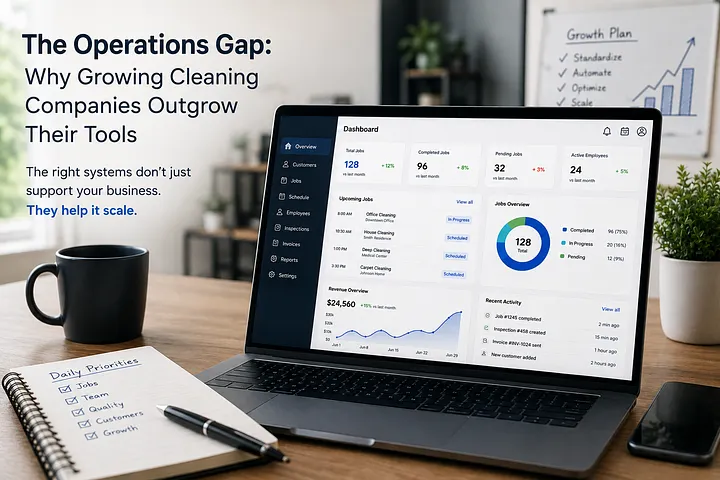
“The business hasn't necessarily become badly organised. It has simply outgrown the way it was organised.”
There is a stage in almost every growing cleaning business when something starts to change.
The company is getting more customers. The team is getting larger. There are more recurring jobs, more locations, more employees, and more things happening at the same time.
From the outside, this looks like success. Operationally, however, growth can create a completely different problem: the systems that worked perfectly when the business was small suddenly start working against it.
A spreadsheet that once made scheduling simple becomes difficult to maintain. A group chat that was convenient for five employees becomes chaotic with twenty. Customer information becomes scattered across emails, notes, calendars, and different applications. Managers spend more time checking whether things are happening than actually managing the business.
This is what we call the operations gap.
When “Good Enough” Stops Being Good Enough
Most cleaning businesses don't start with sophisticated technology. They don't need it.
A small company might successfully manage customers through a spreadsheet, keep appointments in a calendar, communicate with employees through messaging apps, and handle invoices through separate accounting software. At that stage, these tools can be perfectly reasonable.
The problem appears when the business grows faster than its systems. What worked for ten customers may not work for fifty. What worked for five employees may become difficult with thirty. What was once a quick manual task can turn into hours of administrative work every week.
The business hasn't necessarily become badly organised. It has simply outgrown the way it was organised.
Growth Creates More Connections
One of the least obvious effects of growth is that the number of relationships between different parts of the business increases.
- A customer is connected to a service
- The service is connected to a schedule
- The schedule is connected to an employee
- The employee is connected to a location
- The completed job may be connected to a quality inspection, an invoice, and a customer follow-up
When a business is small, one person can keep most of these connections in their head. As the company grows, that becomes impossible.
Information needs to move between people and systems without relying on someone remembering what happened yesterday. This is where operational structure becomes just as important as sales.
The Problem With More Apps
A common response to growth is to add another tool. Need better scheduling? Add a scheduling application. Need customer management? Add a CRM. Need employee communication? Add another messaging platform. Need reporting? Add another dashboard.
Individually, each solution may make sense. But eventually the business can end up with the opposite of what it wanted: more technology, but less visibility.
Employees have to enter the same information in multiple places. Managers switch between applications. Important updates get missed. Reports require manual work.
The issue isn't necessarily that the individual tools are bad. The issue is that they don't always work together.
A Business Needs One Operational Picture
As a cleaning company grows, visibility becomes increasingly important. A business owner should be able to understand what is happening without asking several people and checking multiple systems.
- Which jobs are scheduled today?
- Are there staffing conflicts?
- Which customers require attention?
- Were all services completed?
- Are there outstanding payments?
- Is the team operating at capacity?
These aren't advanced questions. They're basic operational questions. Yet answering them can become surprisingly difficult when information is fragmented.
A connected system can change this by creating a single operational picture of the business.
Standardisation Becomes a Growth Advantage
Another important shift happens when a company moves from being owner-managed to manager-managed. When the owner personally oversees everything, processes can remain informal. But once other managers and team members become responsible for operations, consistency becomes essential.
The business needs clear workflows.
- How is a new customer added?
- How is a recurring service scheduled?
- How is a missed appointment handled?
- How is quality checked?
- How does a manager know when something requires attention?
Standardising these processes doesn't make a business less flexible. It makes the business less dependent on individual memory and individual people.
Technology Should Support the Next Stage of Growth
The answer isn't necessarily to buy more software. It's to think differently about how the business operates.
Technology should help connect information, reduce repetitive work, improve visibility, and make important processes easier to repeat consistently.
This is especially important in cleaning businesses because so much of the operation happens outside a traditional office. Employees are moving between locations. Managers are coordinating schedules in real time. Customers expect quick communication. Changes can happen throughout the day.
The technology supporting the business needs to reflect that reality.
Building for Scale, Not Just for Today
The most important question for a growing cleaning company isn't “Does our current system work?” It probably does. A better question is: “Will our current system still work when we're twice as big?”
That shift in thinking can reveal operational problems before they become expensive ones.
A system that provides structure at 20 employees can make reaching 50 significantly easier. A centralised customer database can prevent information from becoming fragmented. Automated workflows can reduce the amount of administrative work required as the customer base grows.
The goal isn't technology for its own sake. The goal is to create an operation that can handle growth without creating proportional amounts of complexity.
This Is Where Modern Cleaning Software Is Heading
The next generation of cleaning business software isn't simply about replacing spreadsheets. It's about creating an operational layer that connects the different parts of the business.
Scheduling, customers, employees, quality, finances, reporting, and automation shouldn't necessarily exist as completely separate processes. They are parts of the same business.
This is one of the ideas behind Vertex Commercial, a platform built specifically around the operational needs of cleaning companies. Rather than asking cleaning businesses to adapt their operations to generic software, the approach is to build technology around the workflows that already exist in the industry — and make those workflows easier to manage as the business grows.
Key highlights
- Growth multiplies the connections between customers, schedules, employees and locations
- Adding more apps can mean more technology but less visibility
- One operational picture answers basic questions without chasing people
- Standardised workflows reduce dependence on individual memory
What's next
Scaling isn't simply about getting more customers. It's about being able to serve more customers without allowing operational complexity to grow at the same speed.
That's the difference between a business that is busy and a business that is scalable.
The right systems don't replace good people. They give good people better visibility, fewer repetitive tasks, and a clearer way to work together — and for a growing cleaning company, that can become one of the most important competitive advantages of all.
About Vertex Commercial
Vertex Commercial is an all-in-one business management platform built exclusively for cleaning companies.
Our software combines scheduling, workforce management, customer relationships, inspections, invoicing, reporting, and intelligent automation into one connected platform — helping cleaning businesses streamline operations, improve efficiency, and grow with confidence.
Published by The Vertex Commercial Team. The right systems don't just support your business. They help it scale.